The three phases of the cycle, plus common problems like irregular periods, heavy bleeding and cramps — and when to see a doctor.
 menstruation, follicular phase, ovulation and luteal phase" class="art-hero-img" style="object-position:center" loading="lazy"/>
One day, while I was examining patients, a sister came running in: “Madam, please come quickly — Priya feels dizzy and has just vomited.” I went to see her at once, and realised that her period had started that very day.
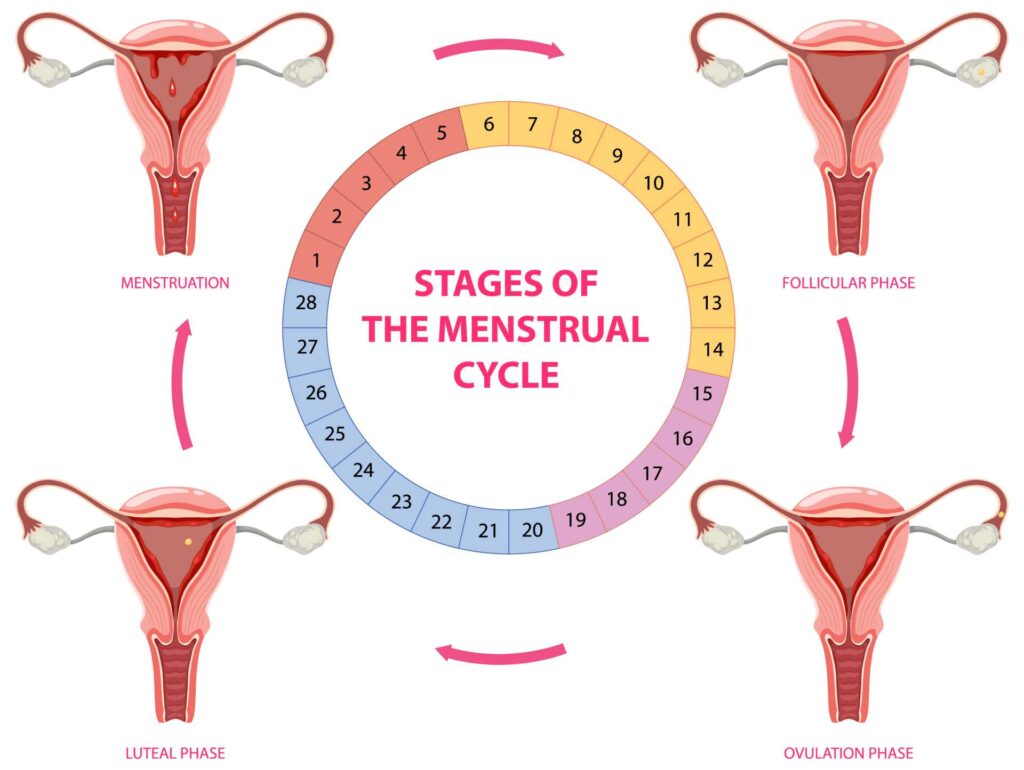
Priya was fourteen years old. It had been a year since her periods began, and almost every month some discomfort would force her to miss school, which worried everyone. So let us understand what actually happens during the menstrual cycle — it has roughly three phases.
1) Follicular Phase — This begins on the first day of the period and lasts until about the thirteenth day. The eggs (ova) inside the ovary begin to mature, while the lining of the uterus (the endometrium) starts preparing for a possible pregnancy. It is controlled by the pituitary gland, and the level of estrogen rises during this time.
2) Ovulatory Phase — Of the eggs that develop, only one matures fully. Under the influence of a hormone (LH), this mature egg is released from the ovary; it is now ready for reproduction. If it meets sperm at this time, pregnancy can occur.
3) Luteal Phase — This begins after the fourteenth day and lasts about fourteen days. A hormone called progesterone is produced in larger amounts, which helps the lining build up to support a pregnancy, and the endometrium thickens. If pregnancy does not occur, this lining is shed — which is what we call the period (M.C.). If pregnancy does occur, the cells around the embryo begin to produce new hormones and the baby starts to grow.
All three phases occur in every woman, though their length varies from person to person. The hormones produced in the body — FSH, LH, estrogen and progesterone — are responsible for these changes.
1) Irregularity — For the first three to four years after periods begin, they can be irregular, because the hormones are not yet fully under control. The cycle may lengthen, so that instead of arriving within forty days a period may come only after two or three months; in some girls this gap can be as long as six months, while in others periods may come every fifteen to twenty days. So up to about the age of seventeen to twenty, it is not necessary that a period must come exactly once a month.
2) Heavy Bleeding — Normally, menstrual bleeding lasts four to five days. If it begins to last longer than this, it is important to consult a doctor. If blood clots form and the bleeding becomes excessive, the cause needs to be investigated. A sudden, very sharp reduction in the amount of bleeding is also abnormal, and that too needs a doctor’s advice.
3) Pain During Periods — Pain in the lower abdomen is a very common complaint, especially in the early years. At first the opening of the uterus is very small and has to open slightly to allow the lining to be shed; the movements of the uterus during this are painful. Pain tends to be greater in the months when ovulation occurs. After childbirth the opening of the uterus becomes a little looser, so period pain is usually less. The pain is generally more intense in young girls, and some may also feel vomiting or dizziness. With a doctor’s guidance, pain-relieving tablets can ease this discomfort, and regular exercise helps too — yoga, especially surya namaskar (sun salutations), can restore physical balance and reduce the pain.
Conditions of the uterus such as adenomyosis and endometriosis can also cause menstrual problems — particularly irregular bleeding and painful periods. Ovarian cysts and fibroids can contribute too. For all of these complaints, you should consult a doctor and get the necessary tests done. Simple investigations such as a blood test and a sonography help diagnose the condition, and treatment is given accordingly.
This article is for general educational and awareness purposes and is not a substitute for personalised medical advice. If periods are very painful, irregular, or unusually heavy, please consult a gynaecologist.
Patient names used in this article have been changed and are fictional. Any resemblance to actual persons, living or dead, is purely coincidental. Cases are presented for educational purposes only.
Dr. Bharati Abhyankar is a senior obstetrician and gynaecologist with over 37 years of experience, specialising in colposcopy, cervical cancer screening, and routine obstetric and gynaecological care.
View Full Profile →Book a consultation with Dr. Bharati Abhyankar — walk-ins also welcome.